The Red Field
Red stands for revolution, and is also the traditional color of good fortune and celebration in Chinese culture.

National Flag of the People's Republic of China
The five-star motif isn't just for flagpoles — here it's reimagined as everyday shapes, favorite animals and famous sights, all rendered in the flag's own red and gold.









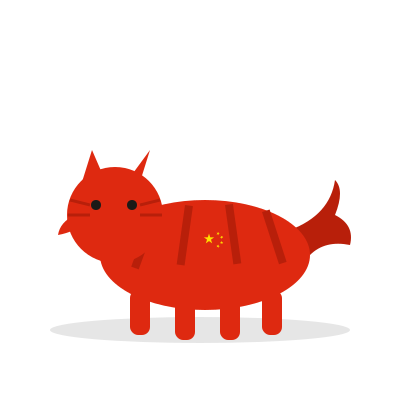
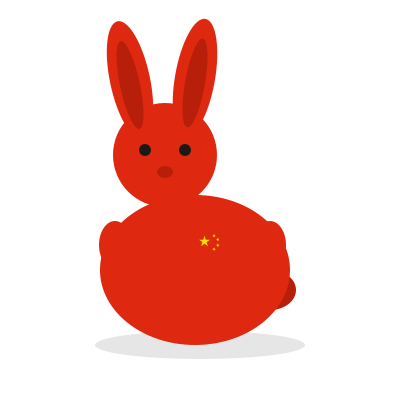
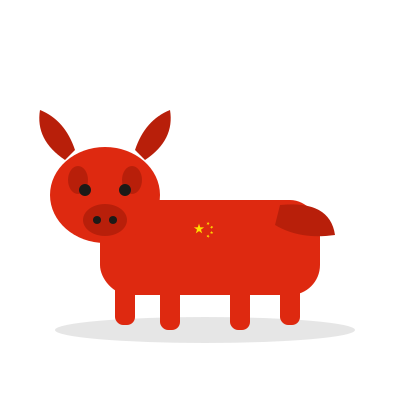
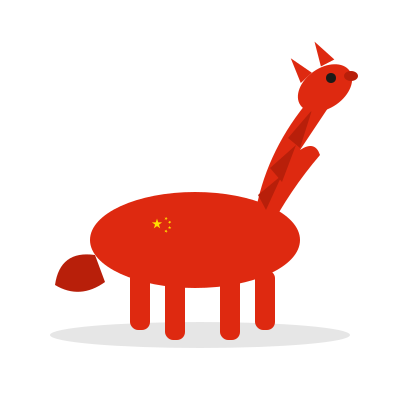

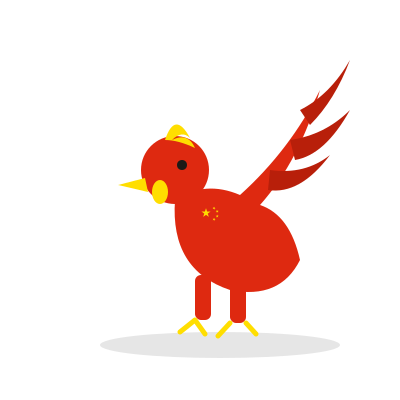










Illustrative renderings created for this site — not official or licensed products, and not an official map.
Image license: All flag illustrations on this page may be downloaded and used free of charge, including for commercial purposes. Attribution (a link to china-flag.cn) is appreciated but not required.
Adopted in 1949, the design blends color, geometry and political history into a single, instantly recognizable emblem.
Red stands for revolution, and is also the traditional color of good fortune and celebration in Chinese culture.
The large golden star represents the leadership of the Communist Party of China.
They represent the great unity of the Chinese people under that leadership — traditionally described as the working class, the peasantry, the urban petty bourgeoisie, and the national bourgeoisie.
Each small star has one point aimed precisely at the center of the large star, symbolizing unity gathered around a common center.
Chosen to stand out brilliantly against the red field, symbolizing the light of revolution illuminating the country.
On 27 September 1949, days before the founding of the People's Republic of China, the Chinese People's Political Consultative Conference formally adopted the Five-Star Red Flag as the national flag. It was first raised over Tiananmen Square on 1 October 1949, at the ceremony proclaiming the new republic.
The winning design came from Zeng Liansong, an economist and amateur artist from Zhejiang, submitted during a nationwide public competition that drew nearly 3,000 entries. His original sketch included a hammer and sickle inside the large star; the selection committee removed it to keep the design simple and distinct from the emblems of other socialist states.
Formal technical standards for the flag's proportions, star geometry and colors were codified in national standards (GB 12982 for construction, GB 15092 for color).
Before the Five-Star Red Flag, China flew very different banners. These stylized illustrations show the three best-known predecessors.
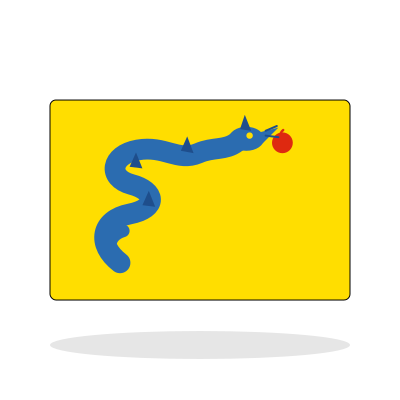
The last imperial dynasty flew a golden-yellow flag with an azure dragon chasing a red pearl — yellow was the emperor's color.

The first flag of the Republic of China: five stripes for the five great peoples of China — Han, Manchu, Mongol, Hui and Tibetan.
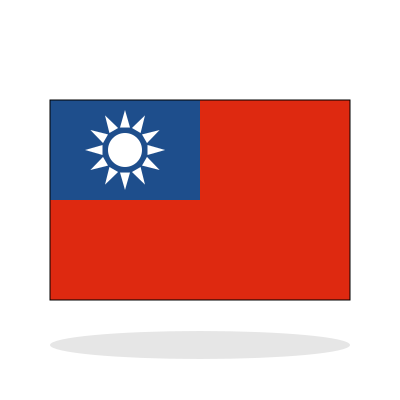
The national flag of the Republic of China era on the mainland until 1949, with a white twelve-ray sun on a blue canton.
3:2
Length-to-width ratio of the flag.
A 30 × 20 unit grid. Large star center (5,5), outer radius 3. Small stars, outer radius 1, centered at (10,2), (12,4), (12,7), (10,9).
The official standard defines colors using physical reference samples, not digital codes — on-screen hex values are close approximations.
Each small star is rotated so that one of its points aligns exactly with the center of the large star.
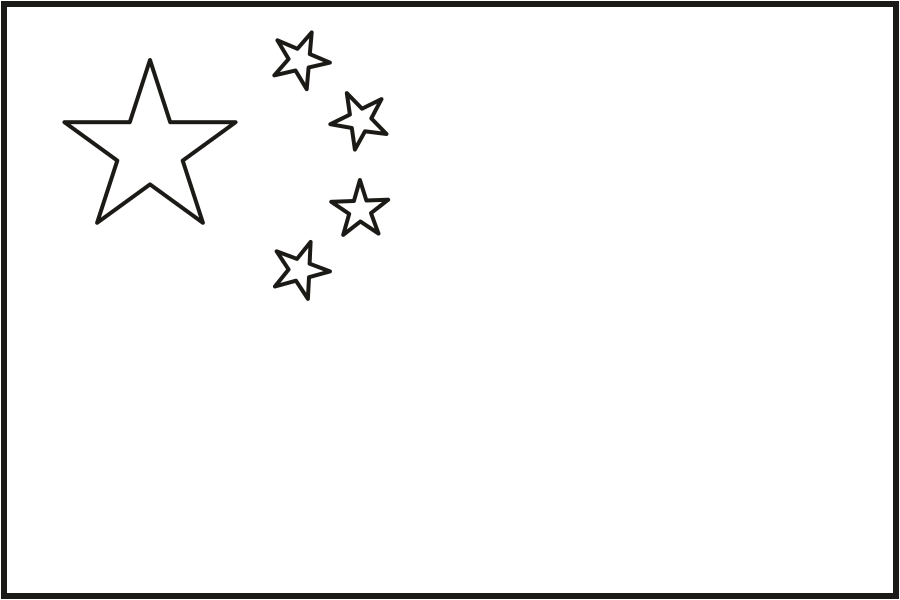
A printable outline of the Chinese flag for coloring in — ideal for school, class projects or a rainy afternoon. Tip: the large star and the four small stars are colored golden yellow on a red field.
The China flag emoji 🇨🇳 consists of the two regional indicator symbols C (U+1F1E8) and N (U+1F1F3). Copy it here with one click.
On some Windows systems the emoji is displayed as the letters “CN” — on phones and most other devices the flag appears.
The flag is flown on national holidays, especially National Day (1 October) and the ensuing Golden Week, as well as at government buildings, schools and border crossings year-round. It must never touch the ground, be flown upside down, or be displayed in a damaged or faded state. On days of national mourning, it is flown at half-mast.
The large golden star stands for the leadership of the Communist Party of China, and the four smaller stars represent the great unity of the Chinese people. Each small star has one point aimed precisely at the center of the large star.
Red and golden yellow. The red field corresponds to Pantone 186 C (roughly #DE2910 on screen), the five stars to Pantone 012 C (roughly #FFDE00). Red symbolizes revolution, yellow the light that illuminates the country.
On 27 September 1949. It was raised for the first time over Tiananmen Square in Beijing on 1 October 1949, the day the People's Republic of China was proclaimed.
Zeng Liansong, an economist and amateur artist from Zhejiang province. His design won a nationwide public competition that drew nearly 3,000 entries.
3:2 — the flag is one and a half times as long as it is high.
Yes. Every illustration in the gallery can be downloaded free of charge as an SVG vector file or as a PNG image.